Long Island City Neighborhood Guide for NYC Newcomers

Most people relocating to New York City from out of state default to Manhattan or Brooklyn without ever seriously considering Long Island City, Queens. That's a costly mistake. Long Island City sits directly across the East River from Midtown, reachable in as few as 5 to 15 minutes by subway, yet its rents run meaningfully lower than comparable neighborhoods in Manhattan. If you are using this Long Island City neighborhood guide to figure out whether LIC belongs on your apartment shortlist, the short answer is yes. The longer answer is that it depends heavily on which part of LIC you land in, what subway lines serve your commute, and what kind of building stock you are expecting.
Table of Contents
- Quick Takeaways
- What Is Long Island City, Really?
- The Sub-Neighborhoods Inside LIC
- Apartment Rents and Housing Stock
- Getting Around: Subway, Ferry, and More
- Arts, Parks, and Everyday Life
- LIC vs. Nearby Neighborhoods: How It Stacks Up
- Practical Tips for Relocating Professionals Moving to LIC
- Frequently Asked Questions
- References
Quick Takeaways
| Key Insight | Explanation |
|---|---|
| LIC is dominated by high-rise rentals and condos | Unlike most NYC neighborhoods, single-family homes and walk-ups are rare in LIC. Expect modern amenity buildings as the primary housing type. |
| Subway access is exceptional | The 7, E, M, G, N, and W trains all serve LIC, connecting riders to Midtown, Downtown, and Brooklyn in well under 20 minutes from most stations. |
| Rents vary sharply by sub-neighborhood | Hunters Point waterfront commands a premium. Court Square and the interior streets offer more competitive pricing for comparable square footage. |
| MoMA PS1 and Gantry Plaza anchor the cultural identity | LIC is not a bedroom community. It has a genuine arts scene, waterfront parks, and a dining corridor along Vernon Boulevard that rivals many Manhattan stretches. |
| The NYC Ferry is a real commute option | The East River Route connects Hunters Point South to East 34th Street and Wall Street, offering a scenic alternative to the subway. |
| Off-market listings matter more here than in most Queens neighborhoods | Many of the newer luxury towers in LIC fill vacancies through broker relationships before listings ever hit StreetEasy publicly. |
| Relocating professionals from out of state frequently underestimate LIC's price range | Median asking rents at newer buildings sit well above the NYC average. A relocation specialist with LIC relationships can find better value than a cold search will surface. |
What Is Long Island City, Really?
Long Island City is a neighborhood in the western edge of the Queens borough of New York City, sitting directly across the East River from Midtown Manhattan. It is a no-frills residential neighborhood located at the western edge of Queens, New York City. It is surrounded by Astoria to the north, the East River to the west, New Calvary Cemetery in Sunnyside to the east, and Newtown Creek, which acts as a boundary between Queens and Greenpoint in Brooklyn, to the south.
For a long time, LIC was defined by its warehouses, auto shops, and industrial infrastructure. That identity has not disappeared, but it has been layered over with residential towers, gallery spaces, and waterfront parks at a pace that caught most of New York City off guard. It's like no one saw the once industrially dominated area of Long Island City rapidly evolve into the up-and-coming, thriving neighborhood it has.
What makes LIC particularly interesting for newcomers is that it is genuinely heterogeneous. You can walk from a gleaming glass tower with a rooftop pool to a block of 19th-century row houses in under five minutes. That range of character is unusual for a neighborhood that has transformed this quickly, and it means the "right" part of LIC depends entirely on what you are looking for.

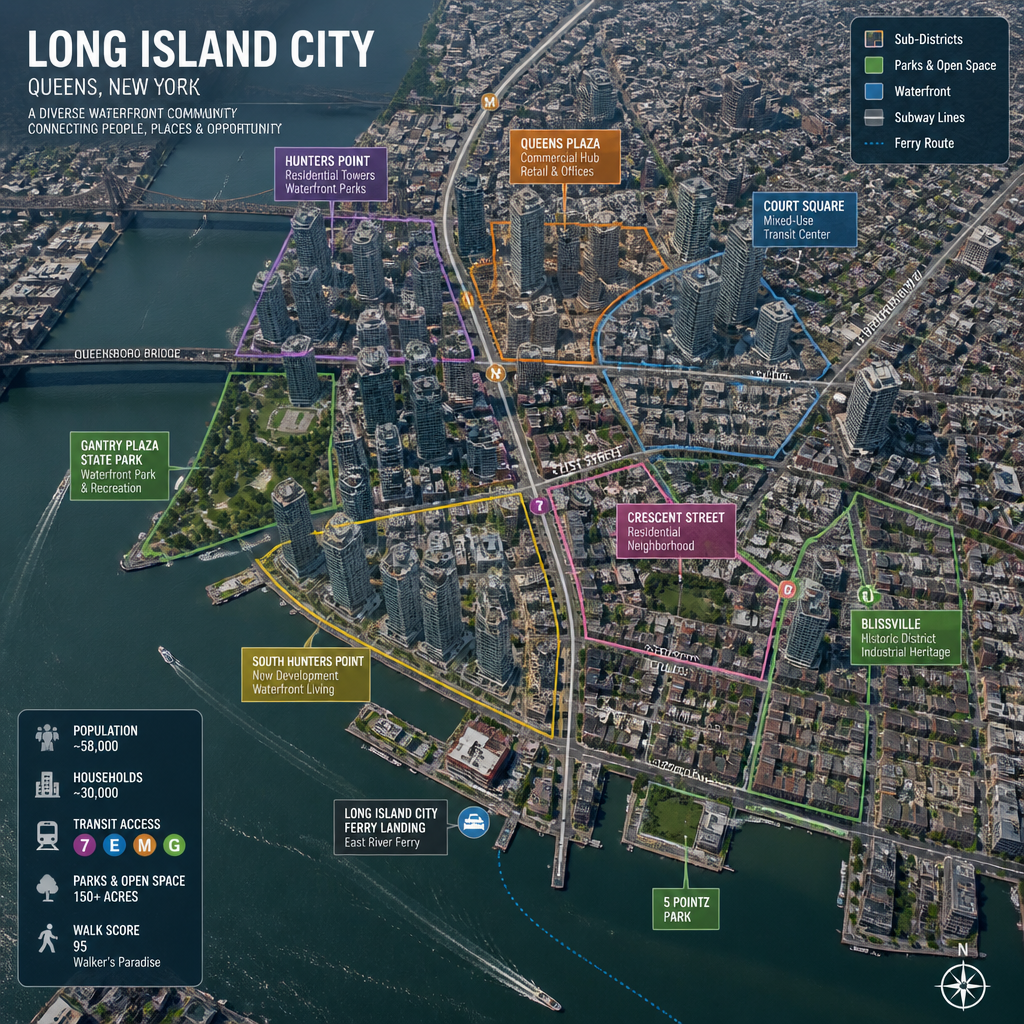
The Sub-Neighborhoods Inside LIC
LIC is not monolithic. Locals and real estate professionals treat it as a collection of distinct pockets, each with a different feel, price point, and apartment type. Understanding these micro-areas before you start searching is one of the most practical things you can do.
Hunters Point
Hunters Point sits on the south end of Long Island City in New York City's Queens borough. The small waterfront neighborhood also houses a historic district with row homes from the 19th century. This is LIC's most visually dramatic sub-neighborhood, defined by the Gantry Plaza State Park waterfront, direct views of the Midtown skyline, and a concentration of luxury high-rises along the water. It is also the most expensive pocket of LIC. If the East River views and the ferry stop at Hunters Point South are priorities, plan accordingly on rent.
Court Square
Court Square is the commercial and transit core of LIC. The subway convergence of the 7, E, M, and G trains at Court Square station makes this the neighborhood's pulse point. This section of the neighborhood is where you'll find high rise apartment buildings, new condo developments, and the more famous LIC attractions. Hunter's Point is also a cornucopia of commerce and cuisine. Court Square appeals most to commuters who want maximum subway flexibility and do not need to be right on the water.
Vernon Boulevard Corridor
Running roughly parallel to the waterfront, Vernon Boulevard has developed into LIC's primary dining and nightlife street. Buildings here are a mix of new construction and older converted lofts. The street has a more neighborhood feel than the towers around Court Square, and apartments along this corridor tend to attract people who want walkable amenity density without paying Hunters Point waterfront premiums.
Queensboro Plaza Area
The northern tip of LIC, clustered around Queensboro Plaza station, is more transitional. It connects directly to Astoria to the north and feels less polished than the rest of LIC. Rents here tend to be lower, and the building stock is more varied, including some older pre-war buildings that are genuinely hard to find in the rest of LIC.
Apartment Rents and Housing Stock
The first thing relocating professionals need to understand about LIC apartments is that the neighborhood skews heavily toward newer construction. Long Island City is mainly composed of condos and luxury rental high-rise buildings. Unlike most other NYC neighborhoods, single-family homes and walk-ups are few and far between.
Rent levels span a wide range depending on where in LIC you look and which building tier you target. Average rental prices in Long Island City run approximately $3,000 per month for a studio, $3,500 for a one-bedroom, $5,000 for a two-bedroom, and $6,600 for a three-bedroom. According to StreetEasy data, the median asking rent in the neighborhood was $4,050 as of April 2024.
The condo ownership market is active too. Near Court Square, a one-bedroom in a small boutique building can run $750,000, while a unit in a newer tower can cost up to $1.9 million. A one-bedroom in a select waterfront building with a view of the East River might cost $1.3 million.
The real estate advantage of LIC is not that it is cheap. It is that, for the proximity to Midtown, the amenity quality in newer buildings, and the transit access, it offers better value than a comparable unit would command in Manhattan or prime Brooklyn.
Pro tip: Many of the best-value apartments in LIC's newer towers are leased through broker relationships before hitting public listings. If you are relocating from out of state and relying exclusively on StreetEasy, you are likely seeing a subset of what is actually available. A specialist with direct relationships inside these buildings can surface inventory you would never find on your own.

Getting Around: Subway, Ferry, and More
LIC's transit access is genuinely one of its strongest selling points and one of the main reasons it keeps attracting relocating professionals who work in Midtown or Downtown Manhattan. Long Island City is served by multiple subway lines, making it a critical transit link between Queens, Brooklyn, and Manhattan.
Subway Lines
The 7 train runs directly through LIC with stops at Court Square and Hunters Point Avenue, providing a fast connection to Grand Central Terminal. The E, M, and G trains also run through Court Square, while the N and W lines serve the nearby Queensboro Plaza station. The 7, E, M, N, and W trains connect LIC to Grand Central, Times Square, Midtown East, and the Upper East Side.
LIC to Midtown often takes 5 to 15 minutes by subway, far below the 50-minute U.S. average commute. That is not a marketing claim. It is a practical reality for anyone living near Court Square or Hunters Point Avenue stations.
NYC Ferry
The NYC Ferry links LIC's Hunters Point South to East 34th Street and Wall Street for $4.50 one way or $15 for a 2-day unlimited pass on the East River Route. The ferry is slower than the subway and weather-dependent, but it is a genuinely pleasant commute on a clear morning and draws a loyal following among LIC residents who work near the East Side waterfront.
Biking and Walking
LIC is one of the more bike-friendly Queens neighborhoods. Citi Bike docks are widespread, and the neighborhood's grid layout makes it navigable on two wheels. The Queens-Midtown Tunnel and the Queensboro Bridge are accessible by bike, and on a clear day the bridge crossing itself is one of the better free experiences in New York City.
Pro tip: If your workplace is anywhere between Grand Central and Hudson Yards, the 7 train from Hunters Point Avenue or Vernon Boulevard-Jackson Avenue is faster than almost any commute option from comparable apartments in Brooklyn. Map your commute before you discount LIC on the assumption that Queens means a longer ride.
Arts, Parks, and Everyday Life
LIC has built a cultural identity that surprises people who expect nothing but glass towers and commuters. The neighborhood has a genuine arts infrastructure anchored by a few institutions that draw visitors from across the city.
This former manufacturing hub is one of NYC's most exciting neighborhoods, with a lively nightlife scene, must-visit restaurants and contemporary art museums. Along the waterfront, green spaces Gantry Plaza State Park and Hunters Point South Park are well suited for picnics and sunset strolls.
MoMA PS1
MoMA PS1 is arguably the most significant contemporary art institution in Queens. It operates as a satellite of the Museum of Modern Art and focuses on experimental work and emerging artists. Its summer Warm Up music and arts series draws thousands of visitors to LIC each year and has been a fixture of the New York summer calendar for decades. For residents, having this kind of programming within walking distance changes the texture of weekend life in a way that is hard to quantify but easy to notice.
Gantry Plaza State Park
Gantry Plaza State Park runs along the East River waterfront in Hunters Point and offers what many consider the best unobstructed view of the Midtown Manhattan skyline from any park in the city. The restored gantries from the neighborhood's industrial era are preserved as landmarks, and the park hosts outdoor events year-round. Maiella is an elegant Italian restaurant set on the Long Island City waterfront, directly beneath the iconic Pepsi sign in Gantry Plaza State Park, with sweeping views of the Manhattan skyline. The Pepsi-Cola sign itself, a relic of a former bottling plant, has become one of the most photographed landmarks in the borough.
Food and Nightlife
Vernon Boulevard is the primary dining corridor, and it has developed well beyond the typical outer-borough strip. Japanese BBQ, upscale Italian, Thai, and handroll bars are all represented within a short walk of each other. Gantry Plaza State Park and the surrounding LIC neighborhood offer a lively nightlife scene with must-visit restaurants and contemporary art museums. The LIC Bar on Vernon is a long-standing neighborhood fixture with a back patio that draws locals year-round.
LIC vs. Nearby Neighborhoods: How It Stacks Up
When relocating professionals are comparing Queens neighborhoods, LIC most often competes with Astoria to the north and Sunnyside to the east, as well as with Brooklyn neighborhoods like Greenpoint or Long Island City's Manhattan-facing counterparts like the Upper East Side. Here is a direct comparison across the factors that matter most to newcomers.
| Factor | Long Island City (LIC) | Astoria, Queens | Greenpoint, Brooklyn |
|---|---|---|---|
| Commute to Midtown Manhattan | 5-15 minutes via 7, E, or M train | 20-30 minutes via N or W train | 25-35 minutes via G train with transfer |
| Apartment Type | Primarily new luxury high-rises and condos; few walk-ups | Mix of pre-war walk-ups, brick buildings, and some new construction | Mix of converted warehouses, townhouses, and new waterfront towers |
| Approximate 1-Bedroom Rent | Roughly $3,500-$4,750/month depending on building and location | Roughly $2,800-$3,800/month | Roughly $3,200-$4,500/month |
| Neighborhood Character | Modern, transit-oriented, active arts scene, waterfront parks | Dense, international dining, strong community feel, more residential | Trendy, artsy, strong cafe and boutique culture, waterfront access |
| Ferry Access | Yes, direct East River Ferry from Hunters Point South | No direct ferry service | Yes, North Brooklyn Ferry route |
The honest verdict: LIC is the right choice if fast Midtown access, newer building amenities, and waterfront proximity are your primary criteria. Astoria wins on neighborhood warmth and slightly lower rents. Greenpoint wins on Brooklyn lifestyle, but the G train is a genuinely inconvenient commute for most Midtown workers.
Practical Tips for Relocating Professionals Moving to LIC
Moving to Long Island City from another state is a different experience than searching from within New York City. The competitive rental market, the preponderance of broker-exclusive listings, and the sheer density of new construction all create specific challenges for out-of-state movers.
Do Not Limit Your Search to Public Listings
A significant share of LIC's luxury rental inventory moves through broker relationships and off-market channels. Buildings with in-house leasing teams often fill apartments before they ever appear on aggregator sites. If you are searching remotely and relying only on what you can find online, you are working with incomplete inventory. A specialist with existing relationships inside LIC's major buildings will consistently show you better options at better prices than a solo search will produce.
Understand What "Luxury" Means in LIC
In Long Island City, "luxury" is not a vague marketing term. Most new buildings include amenity packages that include rooftop terraces, concierge service, fitness centers, and sometimes shared workspaces. These amenities have real monetary value for a relocating professional who would otherwise pay for a co-working membership. Factor the full package into your rent comparison, not just the base rent figure.
Secure Short-Term Housing First, Then Search
Common mistake: Trying to sign a 12-month lease on a specific LIC apartment before you have spent any time in New York City. The sub-neighborhoods feel very different from each other in person. Hunters Point has a different daily rhythm from the Court Square area. Book a furnished short-term rental for your first 30 to 60 days, explore the neighborhood on foot, and then commit to a longer lease once you have a real sense of where you actually want to be.
Know the Broker Fee Landscape
New York City's broker fee rules have shifted in recent years, and in LIC, where many buildings are owner-represented, the fee structure varies significantly from building to building. Some charge no broker fee; others charge one month's rent. Do not assume the fee structure you saw on one listing applies to the next one. Confirm in writing before you invest time in an application.
Pro tip: If you are relocating for work and your employer offers a relocation package, document every LIC-specific cost, including broker fees and move-in deposits, as negotiable reimbursement items. Many employers cover these costs when they are presented as itemized line items rather than as a vague "relocation allowance."
Frequently Asked Questions
Is Long Island City a good place to live for someone new to New York City?
Yes, for the right person. LIC is particularly well suited to relocating professionals who prioritize a fast Midtown or Downtown Manhattan commute, newer apartment amenities, and access to waterfront green space. It is not the best choice for someone who wants a traditional brownstone block feel or a neighborhood with strong pre-war architecture. The area is modern, fast-paced, and transit-rich, which matches well with out-of-state movers who want to land somewhere functional from day one.
What subway lines serve Long Island City?
The 7 train runs directly through LIC with stops at Court Square and Hunters Point Avenue, providing a fast connection to Grand Central Terminal. The E, M, and G trains also run through Court Square, while the N and W lines serve the nearby Queensboro Plaza station. This web of routes is one of the strongest transit profiles of any Queens neighborhood.
How much should I budget for a one-bedroom apartment in Long Island City?
The median asking rent in Long Island City was $4,050 as of April 2024. Specific one-bedroom pricing varies by building type and location within LIC, with Hunters Point waterfront units commanding the highest rents and Court Square interior apartments offering more competitive rates. Budget conservatively and work with someone who has current, building-level pricing data rather than relying solely on published averages.
Is Long Island City safe?
LIC is generally considered one of the safer neighborhoods in Queens, particularly the Hunters Point and Court Square areas where most of the new residential development is concentrated. Like any New York City neighborhood, conditions vary by specific street and time of day. The influx of residential investment and 24-hour foot traffic around transit hubs has contributed to a well-lit, active street environment in the core of the neighborhood.
What is the difference between Hunters Point and Court Square in Long Island City?
Hunters Point is the waterfront-facing southern portion of LIC, characterized by direct East River views, the Gantry Plaza State Park, and a concentration of high-end residential towers. Court Square is the transit core, roughly a 10-minute walk inland, with greater subway line convergence and slightly more commercial energy. Hunters Point is quieter and more residential. Court Square is louder and more connected. Both are within LIC, but they attract residents with different priorities.
Can I find an apartment in Long Island City without a broker?
Some buildings in LIC lease directly and charge no broker fee. However, many of the best-value apartments, particularly those in newer buildings that have not been formally listed, move through broker channels. Attempting a no-broker search in a competitive LIC market typically means seeing a narrower slice of available inventory. For out-of-state movers who cannot tour in person multiple times, working with an experienced relocation specialist almost always produces better outcomes than going it alone.
How long does it take to get from Long Island City to Midtown Manhattan by subway?
LIC to Midtown often takes 5 to 15 minutes by subway. The 7 train from Hunters Point Avenue to Grand Central is one of the fastest cross-borough connections in the entire New York City subway system, and the E and M trains from Court Square reach Midtown and Lower Manhattan reliably in well under 20 minutes.
If you are planning a move to Long Island City or anywhere in NYC and want an expert perspective on which neighborhood and building actually fits your life, share your experience or questions below. Your situation is specific, and the right answer for you depends on details that a general guide cannot fully address.
References
- Long Island City neighborhood overview, housing costs, and geography details
- Long Island City real estate market review with average rental prices by apartment size
- Comprehensive guide to subway lines and transportation options serving Long Island City
- StreetEasy data on LIC median asking rents and sub-neighborhood housing breakdown
- Commute times and transit options from Long Island City to Manhattan

Book your free
relocation inquiry
In 20 minutes, we'll understand your needs and create a personalized plan for your NYC move. No commitment, no pressure — just expert guidance.
+1 (917) 450-8909
Free 20-minute call
All 5 NYC Boroughs
Ready to make your
NYC move happen?
In 20 minutes, we'll understand your needs and create a personalized plan for your NYC move. No commitment, no pressure — just expert guidance.
.avif)