Moving from California to NYC: Relocation Checklist

Every year, thousands of Californians make the jump to New York City, drawn by career moves, cultural energy, or simply the itch for a completely different urban experience. What most of them discover too late is that the mechanics of moving from California to NYC are genuinely unlike any other domestic relocation. The rental market alone operates by its own strict logic, income thresholds are non-negotiable, and the city's neighborhoods can vary more between two subway stops than between two towns in LA. This checklist and neighborhood guide is built specifically for that move, and for the decision points that will define whether your first year in New York goes smoothly or costs you time and money you didn't plan to spend.
Table of Contents
- Quick Takeaways
- Why the California to NYC Move Is Different
- The Complete California to NYC Relocation Checklist
- NYC Neighborhood Guide for California Relocators
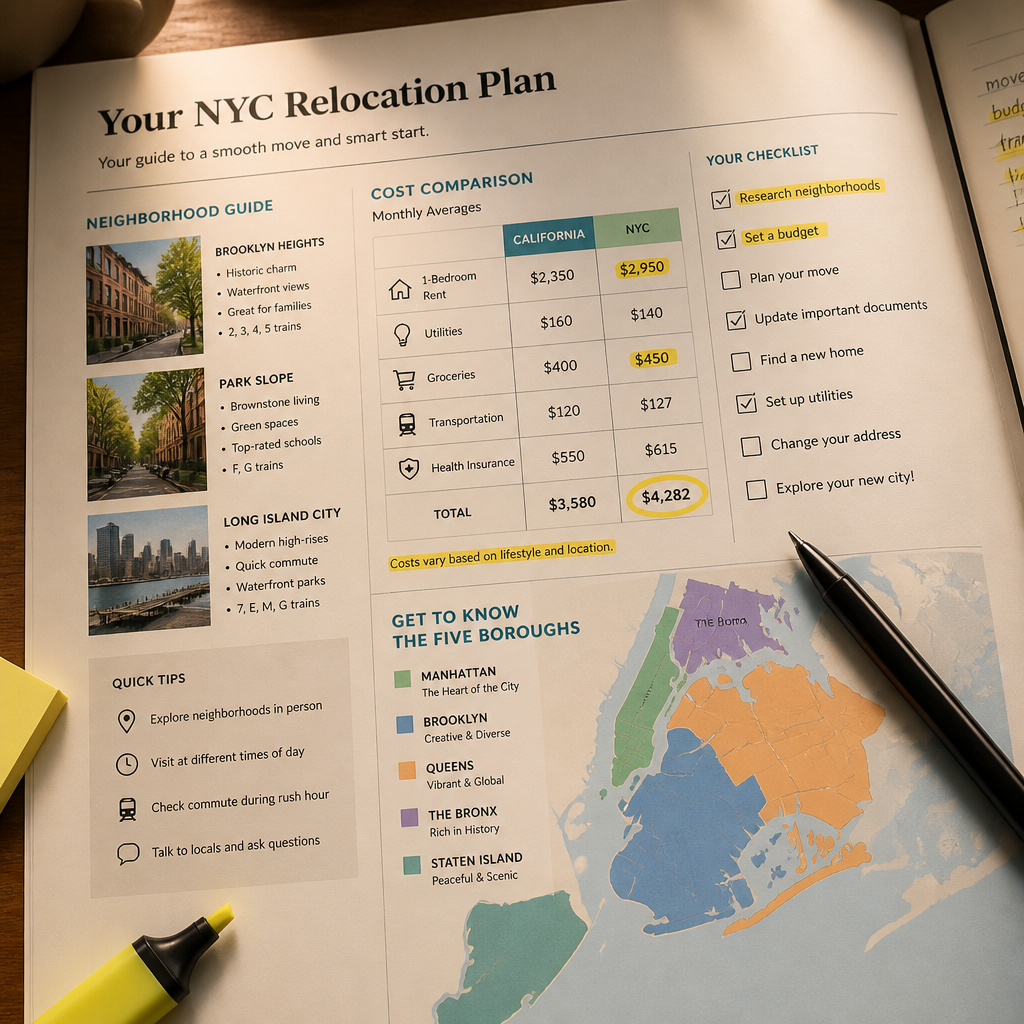
- Cost of Living: California vs. NYC by the Numbers
- Navigating the NYC Rental Market as an Outsider
- Administrative Tasks After You Arrive
- Frequently Asked Questions
- References
Quick Takeaways
| Key Insight | Explanation |
|---|---|
| The 40x rent rule is real and enforced | Most NYC landlords require annual gross income of 40 to 45 times the monthly rent. For a $3,000/month apartment, you need to show $120,000 to $135,000 in verifiable income. |
| New York state is cheaper than California overall | Despite Manhattan's reputation, New York state runs about 8.7% cheaper than California overall, with food costs roughly 38% lower and housing 21% lower statewide. The savings are real once you're settled. |
| Physical moving costs are among the highest domestic routes | The California to New York corridor covers roughly 2,900 miles. Full-service moving costs run from around $1,400 for a studio to over $13,000 for a large home, making this one of the most expensive domestic moves by distance. |
| You have 30 days to get a New York driver's license | New York State requires new residents to obtain a NY license within 30 days of establishing residency. This is one of the shorter windows of any state. Vehicle registration follows the same timeline. |
| Off-market listings are where deals happen | A growing share of desirable NYC apartments never reach major listing platforms. Access to off-market inventory through brokers and insider networks is a meaningful competitive advantage in this rental environment. |
| Broker fees have shifted but not disappeared | Following the FARE Act, landlords now commonly pay broker fees rather than tenants in traditional transactions. However, some landlords keep units off public platforms entirely, and renters still pay for access in certain arrangements. |
| Income tax comparison favors NY at higher salaries | California's top income tax rate is 13.3%. New York State tops out at 10.9%, though NYC residents add a city tax of up to 3.88%. For earners above roughly $85,000, New York can be cheaper in tax terms than California. |
Why the California to NYC Move Is Different
California movers tend to arrive with certain assumptions that work perfectly in Los Angeles or San Francisco and fail immediately in New York City. The most common one is that the apartment search will feel roughly like it does back home: browse listings, schedule tours, apply, and wait. In NYC, that timeline is compressed to days, not weeks. A well-priced apartment in a desirable neighborhood can receive dozens of applications within 48 hours of listing.
The logistics of the move itself are also substantial. The California to New York route covers approximately 2,900 miles, making it one of the longest and most expensive domestic corridors for moving companies. Unlike a local California move priced by the hour, this route is priced on weight and mileage. A one-bedroom move runs roughly $3,500 to $6,200 with full-service movers; a larger home can exceed $13,000.
The other factor that catches California movers off guard is the financial documentation NYC landlords require. The 40x income rule, meaning your gross annual income must equal 40 to 45 times the monthly rent, is standard practice in this market. A $3,500 apartment therefore requires documented income of $140,000 to $157,000. Coming from out of state with a new job offer letter rather than pay stubs creates a specific challenge that requires a prepared response, not improvisation.
The NYC rental market does not reward hesitation. A unit that fits your criteria and your budget will not wait three days while you think it over. Decisions move fast, and the people who land good apartments are the ones who show up prepared to commit.
The Complete California to NYC Relocation Checklist
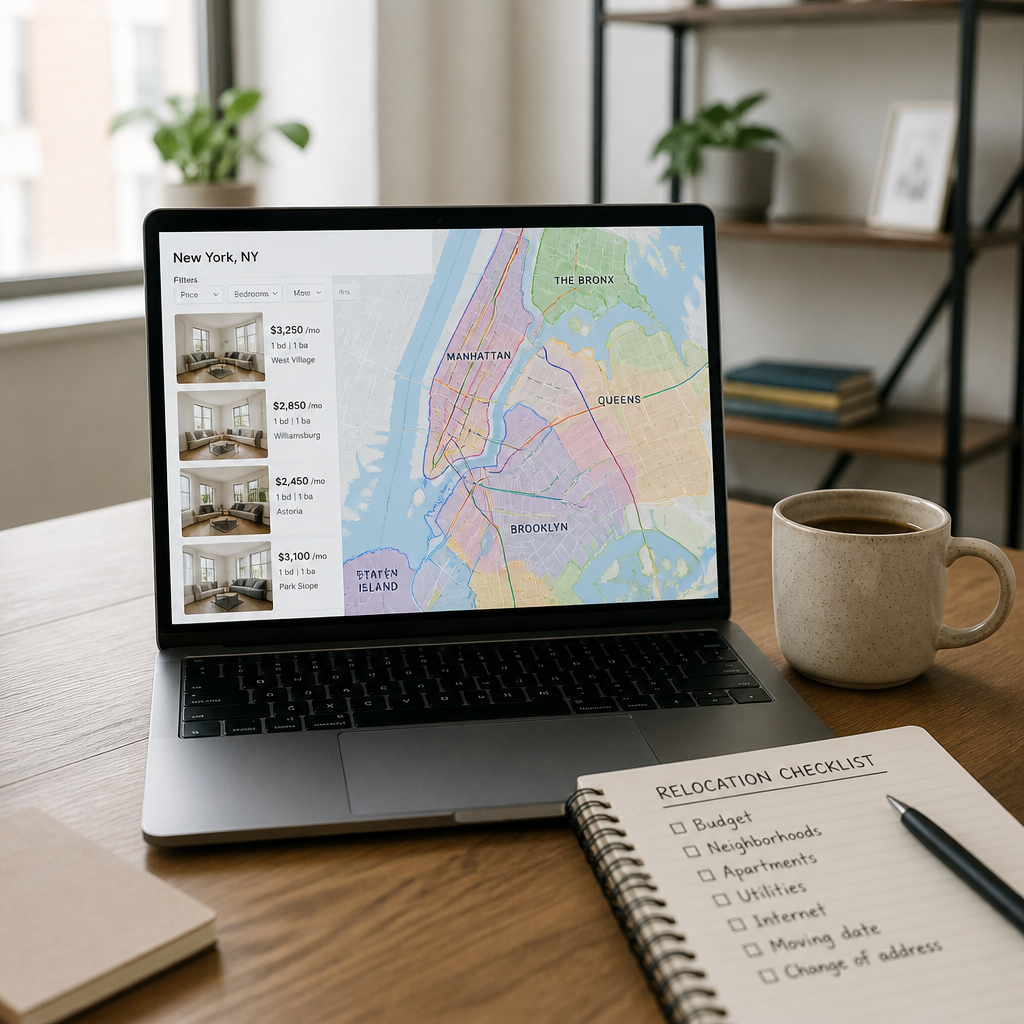
Breaking the move into phases keeps it manageable. The timeline below assumes a move date roughly 90 days out, which is the minimum advisable runway for a cross-country relocation into one of the most competitive rental markets in the country.
90 to 60 Days Before the Move
Start with the financial foundation. Pull together your last three months of bank statements, your two most recent tax returns, and any offer letter or employment contract for your new NYC role. Landlords in New York move quickly once they decide to rent to someone, and having this documentation ready before you begin touring prevents losing apartments to faster applicants.
Research your target neighborhoods seriously during this phase. Do not pick a neighborhood because it sounds familiar or appeared on a streaming show. Map your actual commute from multiple neighborhoods. Factor in whether you need outdoor space, proximity to a specific community, or walkable grocery options. The borough you choose defines your daily life more than the apartment itself.
Get your moving quotes now. Book at least three full-service moving company estimates. The California to New York route is in high demand during summer months. Moving companies fill calendars months in advance for peak season (May through September), and last-minute bookings on this corridor can cost significantly more or may not be available at all.
60 to 30 Days Before the Move
Formally establish your target apartment criteria: maximum rent, minimum bedrooms, required transit access, and any non-negotiable amenities. Having hard criteria prevents decision fatigue when you are touring apartments remotely or making quick calls under competitive pressure.
Begin forwarding your mail and notifying key institutions of your upcoming address change. This includes your bank, investment accounts, health insurance provider, employer HR, and California DMV. California is known for pursuing income tax from former residents who do not properly establish residency elsewhere, so make the paper trail clean from the start.
If you are driving to New York rather than shipping your vehicle, confirm your vehicle is roadworthy for the trip. If you are shipping, research auto transport companies separately from your household goods mover, since most moving companies subcontract vehicle transport and margins vary widely.
30 Days Before the Move
Finalize your apartment search strategy. If you have not yet secured housing, have a short-term furnished option lined up in New York so you are not making permanent decisions under the pressure of homelessness. Extended stay hotels and furnished monthly rentals in Brooklyn or Queens offer breathing room to search properly once you are on the ground.
Confirm your moving date and pickup window in writing with your moving company. Cross-country moves typically involve a delivery window of several days rather than a precise date. Know your window and have a plan for where you will stay if your belongings arrive earlier or later than expected.
Move Week and Arrival
Document every item going onto the moving truck. Photograph boxes and furniture before loading. The California to NYC route is long enough that claims for damaged goods are not uncommon, and documentation is what separates a successful claim from a rejected one.
On arrival, confirm your apartment is in the condition stated in your lease before you sign any move-in documents. Photograph every room, every scratch, every mark on walls. NYC landlords hold security deposits for pre-existing damage that tenants did not document, and this is one of the most avoidable disputes you can prevent with ten minutes of attention.
NYC Neighborhood Guide for California Relocators
Choosing a neighborhood is the most consequential decision you will make during this relocation. Unlike California, where a car handles most of the distance problem, in New York your neighborhood determines how you spend hours of your day. Choose well and the city is effortless. Choose poorly for your specific lifestyle and you will feel it every morning.
Manhattan: Best for Career-First Professionals
Manhattan is the choice for people who want maximum career proximity and can absorb the highest rental costs. Midtown and the areas around it sit at the center of finance, media, tech, and corporate New York. As of early 2026, Manhattan's median rent has reached roughly $4,950 per month, a record level. One-bedroom apartments in well-located buildings run from $3,500 to over $5,000 per month depending on the neighborhood.
Within Manhattan, Harlem and Inwood offer meaningfully lower rents than Midtown or the Lower East Side while remaining on the subway grid. For California transplants who want the Manhattan address without the premium rate of Midtown, the Upper Manhattan neighborhoods deserve serious consideration.
Brooklyn: Best for Lifestyle and Community
Brooklyn is where most California transplants end up, and for good reasons. Neighborhoods like Williamsburg, Park Slope, Carroll Gardens, and Cobble Hill have an energy that resonates with people accustomed to LA's food and culture scene. Brooklyn's median rent sits around $4,000 per month as of early 2026, with significant variation by neighborhood. Park Slope and Cobble Hill lean toward families. Williamsburg and Bushwick attract younger renters and creative professionals.
Downtown Brooklyn is a strong option for people who want access to both Manhattan and the outer boroughs, with rents that are somewhat lower than the most premium Brooklyn neighborhoods while offering excellent transit connections.
Queens: Best for Value and Transit Access
Queens is systematically underrated by newcomers and well-loved by people who have actually lived there. With a median rent around $3,100 per month in early 2026, it delivers real savings while remaining connected to Manhattan by multiple subway lines. Long Island City is ten minutes from Midtown by subway. Astoria has some of the best dining in the five boroughs. Sunnyside, which has a median asking rent around $2,695, offers genuine value and a strong community feel.
For California transplants who arrive with family or who prioritize space over address prestige, Queens consistently delivers the best ratio of square footage to rent in the city.
The Bronx and Staten Island: Overlooked but Worth Knowing
The Bronx has the city's lowest median rents at around $2,250 per month in early 2026 and a cultural energy in neighborhoods like Riverdale and Fordham that most newcomers never discover. Staten Island, at roughly $2,450 per month median, is most relevant for people with cars who prioritize space and quiet over subway access.

Cost of Living: California vs. NYC by the Numbers
The persistent assumption that New York City is categorically more expensive than California is only partially true, and understanding where it is and is not accurate is essential for financial planning before the move.
New York state overall runs about 8.7% cheaper than California, with food costs roughly 38.5% lower, housing about 21% lower statewide, and healthcare around 8.9% lower. These comparisons are statewide figures, so Manhattan proper tilts more expensive than most of California. Brooklyn and Queens, however, are competitive with and sometimes cheaper than comparable neighborhoods in Los Angeles or San Jose.
| Category | California (Statewide Avg.) | New York City (Varies by Borough) |
|---|---|---|
| Median Rent (1BR) | Varies widely; LA averages around $2,300 to $2,800/mo | Manhattan $4,950 median; Brooklyn $4,000; Queens $3,100; Bronx $2,250 |
| Food Costs | Benchmark | Roughly 38.5% lower than California statewide average |
| Transportation | Car-dependent; gas, insurance, parking required | Most residents use transit ($132/month unlimited MetroCard); no car needed |
| State Income Tax (Top Rate) | 13.3% (highest in the U.S.) | 10.9% state + up to 3.88% NYC city tax for city residents |
| Net Take-Home at $150K | Approx. $105,750 after state taxes | Approx. $101,100 after state and city taxes (NYC resident) |
The transportation calculation often surprises California movers most. In New York, most residents do not own a car. The cost of owning and maintaining a vehicle in California, including gas, insurance, registration, and parking, can easily exceed $700 to $1,000 per month. Eliminating that expense and replacing it with a monthly transit pass at roughly $132 is a meaningful financial shift in favor of New York.
Pro tip: If you earn above roughly $85,000 to $90,000 per year, your New York State income tax burden may actually be lower than California's, even before factoring out car expenses. Run the numbers for your specific income before assuming the move will cost you more in taxes. California's 13.3% top rate is the highest in the country, and the gap matters at professional salary levels.
Navigating the NYC Rental Market as an Outsider
The NYC rental market operates with rules and rhythms that differ fundamentally from what most California renters have experienced. Getting this right is the difference between landing a good apartment and spending your first months in New York overpaying for something inadequate.
The Application Process and What You Need Ready
Standard NYC rental applications require: proof of income (typically pay stubs for three months or an offer letter for new employees), bank statements for two to three months, a credit report, landlord references, and government-issued ID. The income requirement of 40 times the monthly rent is non-negotiable at most buildings. For someone starting a new NYC job, an offer letter combined with strong financial reserves can satisfy this requirement, but it needs to be presented proactively and completely.
Out-of-state renters without New York pay stubs face a specific challenge. Landlords see risk in applicants whose income has not yet started. The standard workarounds are: a guarantor (a co-signer with verifiable income in the U.S.), an institutional guarantor service, or a larger upfront security deposit. Knowing which of these your landlord will accept before you apply avoids wasted time.
Broker Fees and the FARE Act
New York's Fairness in Apartment Rental Expenses (FARE) Act shifted the responsibility for broker fees from tenants to landlords in standard transactions. However, the practical effect on the market has been mixed. Some landlords now keep their best units off public listing platforms entirely, filling them through referrals and broker relationships, rather than paying to advertise and cover broker fees. Renters willing to pay for exclusive access to these off-market listings still pay for that access in various arrangements.
The cleanest way to navigate this is to work with a relocation specialist who has genuine off-market access and a clear understanding of current fee structures. The broker fee landscape has changed enough in the past year that anyone advising you on it should be actively working in the NYC market right now, not relying on advice that is even six months old.
No-Fee vs. Off-Market: Understanding the Difference
A no-fee listing means no broker fee is charged to the tenant. This sounds ideal, but the practical reality is that many no-fee listings are on luxury units where the landlord has built the fee into a higher base rent, or they are available to anyone on major platforms and therefore highly competitive. Off-market listings, by contrast, are units that were never publicly advertised. They tend to come from landlord relationships built over years, not from a search filter on a rental app.
Pro tip: The best NYC apartments are often rented before they are listed publicly. If you are searching from California, working with a local relocation expert who has active relationships with landlords and building managers gives you access to this inventory. Searching StreetEasy or Zillow from across the country puts you in competition with every other applicant who has already toured the unit in person.
Administrative Tasks After You Arrive
New York State has firm timelines for administrative transitions that catch out-of-state movers regularly. Falling behind on these creates complications with insurance validity, tax residency, and vehicle legality that are entirely preventable.
Driver's License and Vehicle Registration
New York State requires new residents to obtain a New York driver's license within 30 days of establishing residency. This is one of the shorter mandatory windows of any state. The New York DMV handles all licensing and registration, and in-person visits are required for the initial license application. Bring proof of identity (passport or birth certificate), proof of New York residency (a signed lease plus one utility bill is standard), and your California license.
Vehicle registration follows the same 30-day window. New York requires an annual safety inspection and emissions test. Your California registration and plates must be surrendered as part of the New York registration process.
Establishing New York Tax Residency
California is well known for auditing former residents and claiming they remained California residents even after moving. To establish a clean break, take the following steps promptly after arrival: register to vote in New York, update your address with your bank and financial accounts, obtain a New York driver's license, and file your taxes to reflect the partial-year residency in both states correctly. The cleaner and more documented your residency change, the less exposure you have to California's residency audit process.
Healthcare, Utilities, and Practical Setup
If your new employer provides health insurance, your enrollment window is likely tied to your start date. If you are self-employed or between jobs, New York State's marketplace opens options, and coverage should be set up before your California coverage lapses. Con Edison handles electricity for most of Manhattan and parts of the outer boroughs. National Grid covers gas in many areas. Budget for first-month and last-month deposits on utilities, which many NYC landlords and utility providers require for new accounts.
Pro tip: Change your primary banking address and get a New York ID or license as early in the process as possible. Many NYC landlords and co-op buildings require a government-issued document showing a New York address during the application process itself, not just after you move in.
Frequently Asked Questions
How long does it take to move from California to NYC?
The physical move, meaning the time your belongings are in transit, typically takes 10 to 21 business days for a full-service cross-country move. If you are flying ahead and shipping your belongings, plan for a 2 to 3 week gap between your arrival and your furniture. Most people in this situation either stay in furnished short-term housing or ship a small amount via air freight for the essentials and wait for the rest.
Is it worth hiring a relocation specialist for a California to NYC move?
For most out-of-state movers, yes. The NYC rental market operates on speed, documentation, and insider access. A California resident searching from 3,000 miles away, without local knowledge, without access to off-market listings, and without understanding of which neighborhoods fit their actual priorities, is at a significant disadvantage versus someone working with a specialist who is active in the market daily. The cost of getting it wrong, either by overpaying for an apartment, ending up in the wrong neighborhood, or missing better options that were never publicly listed, typically far exceeds the cost of working with a specialist.
What is the 40x rent rule in NYC?
The 40x rule means that most NYC landlords require applicants to earn an annual gross income equal to 40 times the monthly rent. Some buildings set this at 45 times. This is a firm threshold at most properties, not a guideline. For a $3,000 per month apartment, you need to document $120,000 to $135,000 in annual income. For new employees who have not yet started their NYC job, an offer letter showing a qualifying salary is generally acceptable, but must be accompanied by strong bank statements showing financial reserves.
Which NYC borough is best for someone moving from Los Angeles?
Brooklyn is the most common landing spot for LA transplants, and the fit makes sense. Williamsburg, Cobble Hill, and Park Slope have a density of restaurants, bars, and cultural spaces that resonates with people used to LA's lifestyle. For people prioritizing value, Queens offers more space and strong transit connections at meaningfully lower rent. Manhattan is the right choice if career proximity and urban intensity are the top priorities and budget allows for it. There is no universal right answer, but Brooklyn and Queens together cover the needs of most California relocators well.
Do I need a car in New York City?
Most New Yorkers do not own cars, and most California transplants who bring their car to NYC end up either selling it or paying significant monthly costs to park it. Parking in Manhattan can cost $400 to $600 per month or more. The subway and buses cover the city well, and apps like Citi Bike, Zipcar, and standard rideshare fill the gaps. Unless you are moving to Staten Island or a specific outer borough neighborhood with limited transit access, arriving without a car is generally the financially smarter move.
How much should I budget for the physical move from California to NYC?
Budget based on your home size. A studio or one-bedroom with full-service movers runs roughly $1,400 to $6,200 on this route. A two or three-bedroom is approximately $4,100 to $8,500. A four or more bedroom home can reach $13,000 or above. These figures are for household goods only. Shipping a vehicle separately adds to the total. If cost is the primary concern, a portable container service or renting a trailer and driving it yourself can reduce costs significantly, though the logistics and effort are considerably higher.
Have you made the move from California to New York City, or are you currently planning it? Share the questions or surprises you encountered in the comments below.
References
- California to New York moving costs, taxes, and cost of living comparison guide (2026)
- Comprehensive guide to living in New York City with borough rent comparisons (2026)
- StreetEasy's top NYC neighborhoods to watch in 2026, with rent data by area
- How NYC's FARE Act is reshaping the rental market and off-market apartment listings
- NYC apartment rental tips including broker fees, application requirements, and tenant guidance



Book your free
relocation inquiry
In 20 minutes, we'll understand your needs and create a personalized plan for your NYC move. No commitment, no pressure — just expert guidance.
+1 (917) 450-8909
Free 20-minute call
All 5 NYC Boroughs
Ready to make your
NYC move happen?
In 20 minutes, we'll understand your needs and create a personalized plan for your NYC move. No commitment, no pressure — just expert guidance.
.avif)