NYC Rental Application Tips: What Landlords Want

You found the apartment. The location is right, the price is workable, and your move-in date lines up. Then you lose it to another applicant within 24 hours. If you are relocating to New York City from out of state, this is not bad luck. It is what happens when you compete in one of the most aggressive rental markets in the country without knowing the specific rules that NYC landlords use to screen applicants. The good news is that those rules are knowable, and once you understand them, you can prepare an application that makes a landlord say yes before a competing renter even shows up. These NYC rental application tips are built for exactly that situation.
Table of Contents
- Quick Takeaways
- The 40x Income Rule: The First Filter Every NYC Landlord Uses
- Credit Score: What NYC Landlords Actually Check
- Documents You Need Before You Start Applying
- How to Handle NYC Landlord Requirements as an Out-of-State Applicant
- Self-Employed, Freelance, and 1099 Applicants
- Guarantors: When You Need One and What They Must Prove
- How to Stand Out Beyond the Numbers
- Application Mistakes That Kill Approvals
- Frequently Asked Questions
- References
Quick Takeaways
| Key Insight | Explanation |
|---|---|
| The 40x income rule is the baseline | NYC landlords typically require your annual gross income to be at least 40 times the monthly rent. For a $3,500 apartment, that means $140,000 in annual income. |
| A credit score around 700 is the minimum floor | Most NYC landlords expect a score of roughly 700 or higher. Anything below raises immediate red flags, regardless of how strong your income looks. |
| Your application packet must be complete on submission | Landlords in NYC often move on to the next applicant rather than wait for missing documents. Have every item ready before you tour. |
| A landlord reference letter is not optional if you have one | A short letter confirming you paid on time and respected neighbors can tip a competitive application in your favor, especially if your income profile is non-traditional. |
| Guarantors must earn 80x the monthly rent | Personal guarantors face stricter thresholds than tenants and typically need to live in the tri-state area (New York, New Jersey, or Connecticut). |
| Application fees are capped at $20 by New York State law | If you bring your own recent background or credit check, the landlord is legally required to waive the application fee entirely. |
| Clustering multiple applications saves your credit score | Applying to several apartments within a short window (roughly 14 to 45 days) typically counts as a single inquiry under most credit-scoring models, not multiple hard pulls. |
The 40x Income Rule: The First Filter Every NYC Landlord Uses
Before a landlord looks at anything else, they run your income against one number. Most NYC landlords require your annual gross household income to be at least 40 times the monthly rent. If the apartment is $3,000 per month, you need $120,000 in annual income. At $4,500 per month, you need $180,000. This is not a guideline. For the vast majority of buildings, it is a hard cut-off.
Some landlords set the bar slightly higher, requiring 45x or even 50x the monthly rent. The 40x figure is the widely recognized floor, not a guarantee. If you are combining income with a partner or roommate, both incomes can generally be counted together, which is a meaningful advantage for dual-income applicants.
The income calculation is based on gross income, meaning before taxes. NYC landlords use this pre-tax figure even though your take-home pay is considerably less. Do not confuse the two when assessing whether you qualify for a specific apartment.
Pro tip: Before touring any apartment in NYC, calculate 40x the monthly rent and confirm your gross annual income meets or exceeds it. Falling short even slightly often results in a flat rejection, and no amount of savings or references will override the income formula for most large management companies.


Credit Score: What NYC Landlords Actually Check
NYC landlords run a full credit report, not just a score. They are looking at the score itself, your payment history, any delinquencies, collections accounts, and whether you have any landlord-tenant court records. Each of these carries different weight.
What a passing score looks like
A credit score of around 700 is generally the threshold landlords expect for an unassisted application. Scores above 750 put you in a strong position. Scores below 650 will generate questions and likely require a guarantor or a larger security deposit workaround, though since 2019 New York law significantly limited landlords' ability to collect extra security deposits beyond one month's rent.
What damages an application more than a low score
A few late payments a couple of years ago are manageable. Active delinquencies and collections accounts are serious problems. A landlord-tenant court record, meaning a prior eviction proceeding, is often an automatic rejection. NYC landlords can access Housing Court records, and many screening services pull this data routinely.
Landlords are not just checking a number. They are reading a financial narrative. A clean credit history with a modest score often beats a high score with a messy payment history underneath it.
How to manage multiple applications without damaging your score
Applying to several apartments within a short window, typically 14 to 45 days, often counts as a single inquiry under most credit-scoring models. This means you should cluster your apartment tours and applications rather than spacing them out over months. Three applications in two weeks causes far less credit-score damage than one application per month for three months.
Documents You Need Before You Start Applying
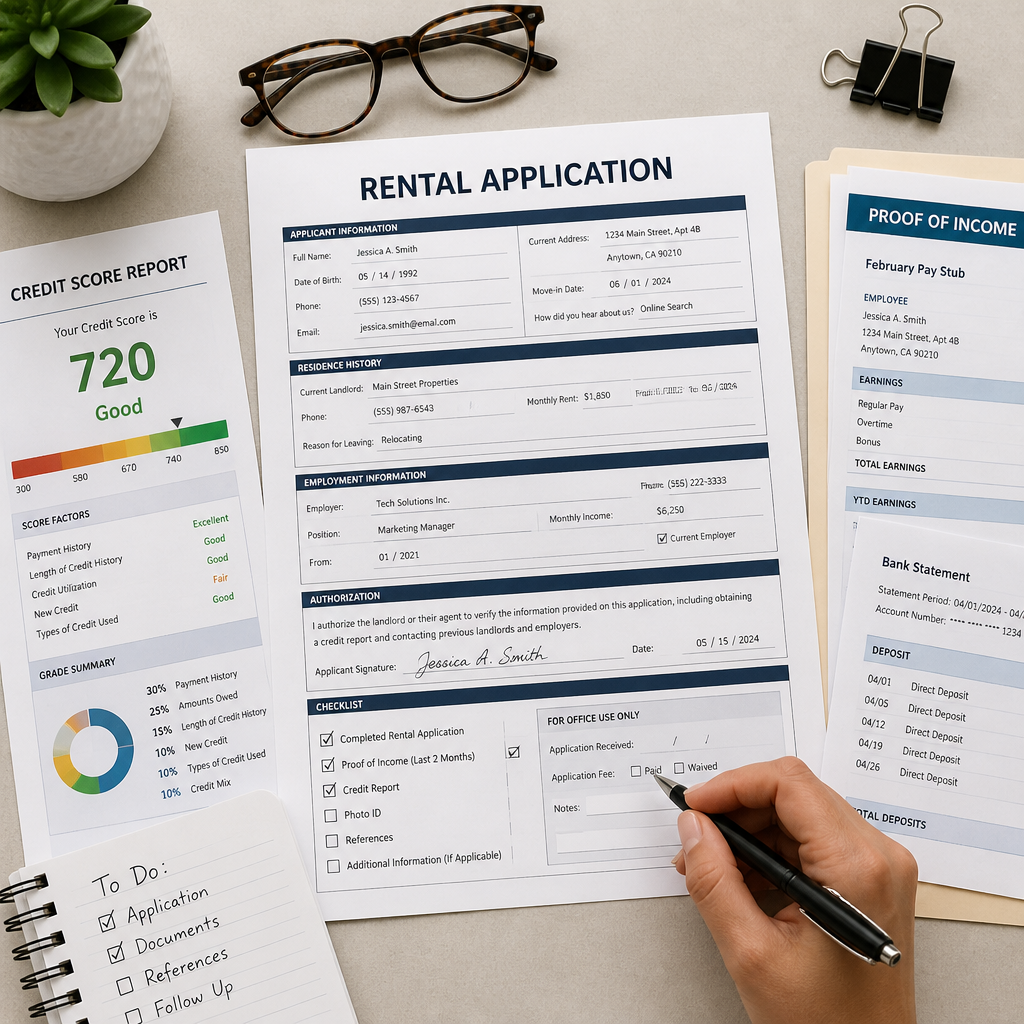
NYC landlords move fast, and a slow applicant is a rejected applicant. The standard document package needs to be ready before you tour, not assembled afterward. Here is what nearly every landlord will require.
For salaried W-2 employees
- Two most recent pay stubs
- Most recent W-2 or offer letter on company letterhead (especially useful for new hires who have not yet received a full year of pay stubs)
- Two to three months of bank statements showing your name, account number, and every page of the statement
- Government-issued photo ID (a driver's license or passport; a student ID is not accepted)
- Completed rental application form
- Landlord reference letter, if available
For self-employed and 1099 workers
- Two years of filed tax returns
- A letter from your CPA confirming prior-year income and current-year income estimate
- Three to six months of bank statements
- Client letters or contracts demonstrating ongoing, active income
- A year-to-date profit and loss statement
Pro tip: Show at least two to three months of rent in accessible bank account funds as a tenant, and aim for more if your income source is non-traditional. Landlords use liquid savings as a secondary stability signal when your income documentation raises any questions.
Bank statements must typically include every page, not just a summary. Submitting an incomplete statement is a common mistake that creates unnecessary delays or suspicion.
How to Handle NYC Landlord Requirements as an Out-of-State Applicant
Out-of-state applicants face one friction point that local applicants do not: NYC landlords cannot easily verify employment through familiar local networks, and they cannot rely on a Housing Court search in the New York system to confirm your rental history. This puts the burden of proof entirely on your documentation.
Start-date employment letters carry extra weight
If you are relocating for a new job and have not yet started, a formal offer letter on company letterhead specifying your start date and annual salary is broadly accepted by NYC landlords. This is one of the more applicant-friendly aspects of the process for professionals relocating for work. Make sure the letter includes your title, compensation, and start date explicitly.
Remote workers face a different challenge
Remote workers relocating to NYC often have strong income but no local employment anchor. Your documentation needs to be exceptionally clean. This means two years of tax returns, recent bank statements showing consistent monthly deposits that reflect your stated income, and ideally a letter from your employer or clients confirming your ongoing engagement.
Your out-of-state rental history still matters
NYC landlords care about rental payment history regardless of where you rented. A reference letter from your most recent out-of-state landlord confirming that you paid rent on time and maintained the property in good condition is worth obtaining before you begin your search. For a relocating applicant, this letter often carries more weight than it would for a local applicant, simply because it is one of the few direct behavioral indicators the landlord has to work with.
Self-Employed, Freelance, and 1099 Applicants
NYC landlords are risk-averse by nature, and self-employed applicants represent a category they view as unpredictable. This is not personal. A salaried W-2 employee represents a predictable, recurring payment. A freelancer represents variable income, potential dry spells, and more administrative work to verify. Understanding this framing is the first step toward overcoming it.
The CPA letter is your most important document
A letter from a licensed CPA confirming your prior year's income and your estimated current-year income is standard practice for self-employed applicants. This letter should be on official letterhead and must include both figures clearly. It is not optional. Without it, most landlords will not process your application past the initial review stage.
How to present your income as stable
Aggregate your income across your bank statements to show consistent monthly deposits. If you have long-term client contracts or retainer agreements, attach them. The goal is to turn a variable income narrative into a stable income narrative through documentation. An applicant who earns $150,000 a year but can only show irregular payments will lose to a salaried applicant earning $100,000, even though the freelancer has higher absolute income. Presentation matters as much as the underlying number.
Guarantors: When You Need One and What They Must Prove
A guarantor is someone who legally agrees to cover your rent if you fail to pay. NYC landlords use guarantors as a risk-offset when an applicant does not fully meet the financial requirements on their own. If you are new to the workforce, a student, self-employed with irregular income, or new to credit, a guarantor is often the path to approval.
Personal guarantor requirements
Personal guarantors face considerably stricter income standards than applicants. They are typically required to earn 80 times the monthly rent annually, compared to the 40x threshold for tenants. A guarantor for a $3,000 apartment needs to show $240,000 in annual income. They also need good credit, typically around 800, and most landlords require them to live in the tri-state area: New York, New Jersey, or Connecticut.
Your guarantor will need to submit much of the same documentation you do: tax returns, bank statements, photo ID, and a completed application. If you have roommates, most landlords will only accept a single guarantor for the entire lease, meaning that person is on the hook for the full rent, not just your share.
Institutional guarantors as an alternative
If you do not have a personal guarantor who meets the requirements, institutional (or third-party) guarantor services exist as a paid alternative. These companies charge a fee and take on the guarantor role contractually. Not every building accepts institutional guarantors, and the building's management company may specify which services it will and will not work with. Always confirm acceptance before spending money on this option.
How to Stand Out Beyond the Numbers
Meeting the minimum thresholds gets your application into the review pile. Standing out is what gets it approved when multiple qualified applicants are competing for the same unit.
The landlord reference letter
A reference letter from a prior landlord is not legally required, but it functions as social proof in a market where landlords cannot fully vet out-of-state applicants. The letter should confirm that you paid rent on time, maintained the property respectfully, and caused no issues with neighbors. A letter from a well-known management company or large landlord carries additional credibility because it signals that the reference came from a professional organization with real accountability, not just a private individual vouching for a friend.
A reference letter can also help bridge gaps. If you work non-traditional hours, work from home, or have an unconventional income profile, a landlord reference letter that speaks to your reliability as a tenant adds a human dimension to your application that financial documents cannot provide.
Speed and completeness as a competitive advantage
NYC rental units move within days. Landlords do not wait for applicants to gather missing documents. Submitting a complete, organized application packet the same day you tour signals seriousness and preparation. A landlord who receives three applications in 48 hours will process the most complete one first. Being organized is not just a courtesy. It is a competitive strategy.
Comparison: Application Approaches and Their Effectiveness
| Approach | Best For | Key Risk or Limitation |
|---|---|---|
| Standard W-2 application with full document packet | Salaried employees who clearly meet the 40x income rule and have a credit score of 700+ | Weakened if any single document is missing or if credit has recent derogatory marks |
| Self-employed application with CPA letter and P&L statement | Freelancers, consultants, and business owners with stable annual income but variable monthly payments | Requires more documentation than W-2 applicants; some landlords remain hesitant regardless of income level |
| Personal or institutional guarantor-backed application | New-to-credit applicants, recent graduates, international relocators, or anyone below the 40x income threshold | Guarantor must meet an 80x income requirement; institutional guarantors are not accepted by all buildings |
Application Mistakes That Kill Approvals
Most application failures are avoidable. These are the mistakes that show up repeatedly among out-of-state applicants who are unfamiliar with how NYC landlord requirements actually work in practice.
Submitting incomplete bank statements
Landlords typically require every page of a bank statement, not a summary page or a screenshot from a banking app. Submitting a partial statement raises questions about what is being hidden, even if the omission was accidental. Download and submit the full statement PDF directly from your bank's portal.
Applying for apartments you cannot afford on paper
Some applicants apply for apartments where their income falls short of the 40x rule, planning to negotiate or explain the gap. This rarely works with professional management companies. Applying outside your income range wastes time and adds unnecessary hard inquiries to your credit report.
Underestimating move-in costs
NYC move-in costs are front-loaded and can be substantial. First month's rent, one month security deposit, and a broker fee (when applicable) can add up to several months of rent due at signing. Having certified funds available and documented in your bank statements before you apply matters. A landlord who sees that you can barely cover move-in costs will view you as a financial risk regardless of your income.
Not having a guarantor ready before you need one
If there is any chance your income or credit will not fully satisfy a landlord's requirements, identify your guarantor and brief them on the process before you start applying. Telling a landlord you need to find a guarantor after they have accepted your application in principle introduces delay and uncertainty that often ends with the apartment going to someone else.
Pro tip: If you are working with a relocation specialist who has established relationships with NYC landlords and property managers, they can often flag which buildings are more flexible on documentation requirements and which ones apply strict 40x or 45x rules. That intelligence alone can save you multiple failed applications and unnecessary credit inquiries.
Frequently Asked Questions
What credit score do I need to rent an apartment in NYC?
Most NYC landlords look for a credit score of around 700 as a baseline for an unassisted application. Scores above 750 are considered strong and reduce the likelihood of additional scrutiny. Scores below 650 typically require a guarantor or a more robust income profile to offset the risk perception. More important than the score itself is the absence of active delinquencies, collections, or Housing Court records.
How do I prove income for an NYC rental application if I just accepted a new job?
A formal offer letter on company letterhead that clearly states your job title, start date, and annual salary is widely accepted by NYC landlords as proof of income for new hires. This is particularly common for professionals relocating to NYC for work. Make sure the letter is signed, on official stationery, and includes your compensation details explicitly.
Can I use a guarantor from out of state?
Most NYC landlords prefer personal guarantors who live in the tri-state area, meaning New York, New Jersey, or Connecticut. Some landlords are beginning to accept out-of-state guarantors, but this remains the exception rather than the rule. If your guarantor lives outside the tri-state area, confirm the building's policy before counting on that person as your backup. An institutional guarantor service may be a more reliable alternative in that situation.
What is the application fee cap in New York City?
New York State law caps rental application fees at $20 per applicant. Additionally, if you provide your own recent background or credit check report, the landlord is legally required to waive this fee entirely. This protection applies statewide, including in all five NYC boroughs.
Does applying to multiple NYC apartments at once hurt my credit score?
Applying to multiple apartments within a short period, roughly 14 to 45 days, typically results in multiple hard inquiries being counted as a single inquiry by most credit-scoring models. This means clustering your applications is significantly better for your credit score than spacing them out over several months. Plan your apartment tours in batches rather than stretching your search over a long timeline.
What should a landlord reference letter include?
A landlord reference letter should confirm that you were a tenant in good standing, paid rent on time consistently, and maintained the property respectfully. It should ideally be on letterhead, signed, and include the tenancy dates and the property address. A letter from a large management company or professional property manager tends to carry more weight than one from a private individual landlord, simply because it comes from an accountable professional source.
How is the NYC rental application process different for self-employed applicants?
Self-employed, freelance, and 1099 applicants face additional documentation requirements compared to salaried employees. Expect to provide two years of filed tax returns, a CPA letter confirming income, three to six months of bank statements, and potentially client contracts or invoices proving active income. The goal is to demonstrate income stability, since NYC landlords view variable income as a higher risk profile than a fixed salary. A strong savings balance and a clean credit history help offset this perception significantly.
Have you recently gone through the NYC rental application process as an out-of-state mover? Share what worked, or what caught you off guard, in the comments below.
References
- Complete NYC apartment application checklist covering income requirements, documents, and bank statement standards
- OpenIgloo's guide to the eight documents NYC renters need and guarantor income thresholds
- Brick Underground breakdown of how landlord reference letters affect NYC rental applications
- Brick Underground guide to filling out an NYC rental application including guarantor tri-state requirements
- What credit score is needed to rent in NYC and how credit inquiries work during apartment searches



Book your free
relocation inquiry
In 20 minutes, we'll understand your needs and create a personalized plan for your NYC move. No commitment, no pressure — just expert guidance.
+1 (917) 450-8909
Free 20-minute call
All 5 NYC Boroughs
Ready to make your
NYC move happen?
In 20 minutes, we'll understand your needs and create a personalized plan for your NYC move. No commitment, no pressure — just expert guidance.
.avif)