How to Apartment Hunt in NYC Remotely: A Guide

Signing a lease on an apartment you have never physically walked through, in a city you may have only visited once or twice, is genuinely nerve-wracking. Yet thousands of people do it every year when moving to New York City from out of state. The problem is that most generic remote apartment search advice was not written for NYC's specific competitive conditions. Apartment hunt NYC remotely and you are not just competing with local renters. You are competing with them while operating on a time delay, without local contacts, and often without a full understanding of how Manhattan, Brooklyn, Queens, the Bronx, and Staten Island differ from each other at the block level. This guide gives you a realistic, step-by-step process that actually works.
Table of Contents
- Why NYC Remote Apartment Hunting Is Different
- Timeline: Start Earlier Than You Think
- Nail Down Your Neighborhood Before You Search Listings
- Building Your Remote Search Toolkit
- Virtual Tours: What to Ask and What to Watch For
- The NYC Application Package: Prepare It Before You Need It
- Avoiding Rental Scams as an Out-of-State Renter
- When to Use a Specialized Relocation Service
- Comparison: Approaches to Remote Apartment Hunting in NYC
- Frequently Asked Questions
- References
Why NYC Remote Apartment Hunting Is Different
New York City's rental market operates on different rules than almost every other city in the country. Vacancy rates hover around 2.8% to 3.0%, far below the national average of roughly 8%. That means competition for available units is severe, and landlords rarely need to wait for the right tenant. Good apartments at fair prices are claimed within days, sometimes hours, of being listed.
For an out-of-state renter, this creates a structural disadvantage. You cannot drop everything and tour an apartment the afternoon it goes live. You cannot build a feel for a neighborhood by walking it at different times of day. And you cannot hand a landlord a signed application over the counter before anyone else does. Every step in your process carries a delay that local renters do not face.
The good news is that this disadvantage is solvable with preparation. The renters who successfully complete a remote apartment search NYC do not succeed by moving faster. They succeed by having everything organized before the search begins, so that when the right listing appears, their response time is nearly as fast as someone who lives locally.
Timeline: Start Earlier Than You Think
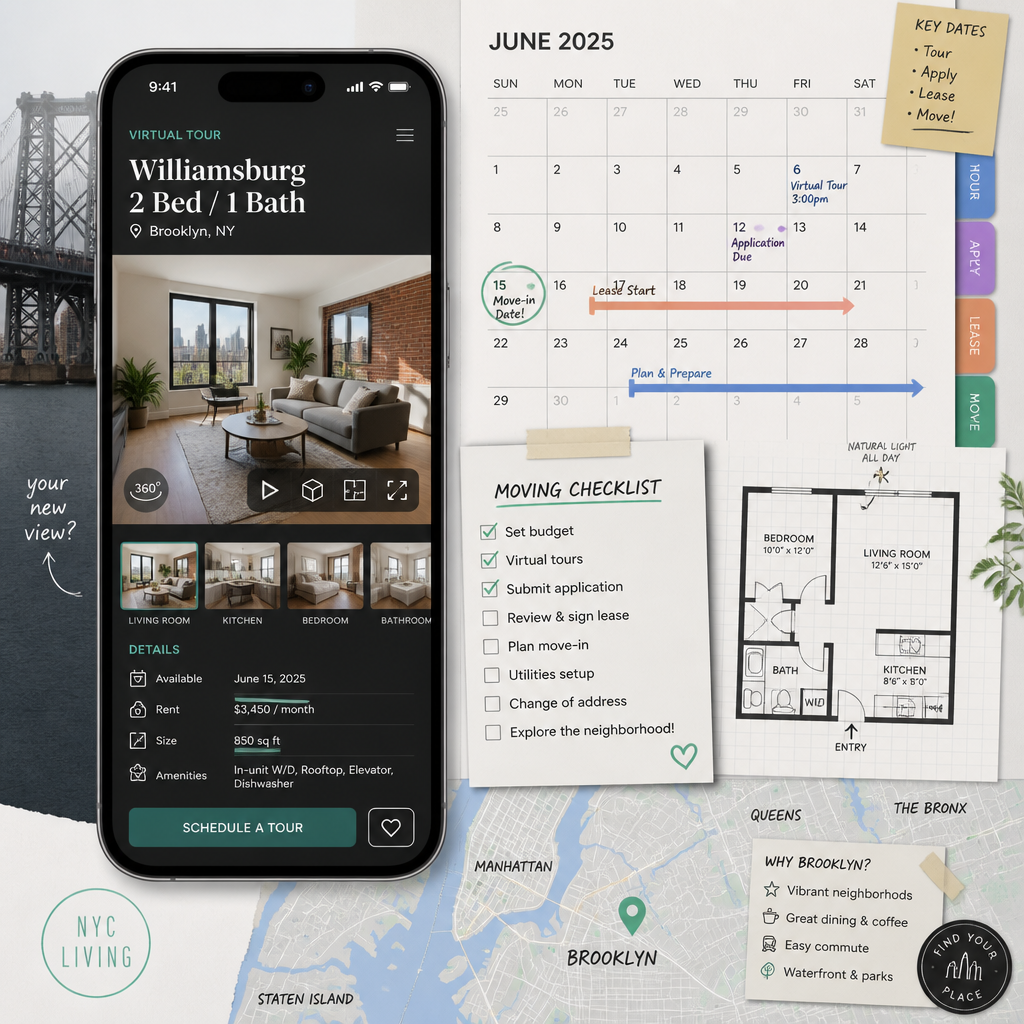
Starting your search eight to twelve weeks before your intended move date is the minimum for an out-of-state move. That window gives you enough time to research neighborhoods, engage with landlords or brokers, prepare your application documents, and handle the logistics of the move itself without being forced into a bad decision by the calendar.
A realistic timeline for most out-of-state movers looks like this:
- 10 to 12 weeks out: Research neighborhoods, define your budget including all upfront costs, and begin building your application package.
- 8 to 10 weeks out: Begin actively monitoring listings on StreetEasy, Zillow, and direct-to-landlord platforms. Set up saved searches with alerts.
- 6 to 8 weeks out: Schedule virtual tours. If you can make a single trip to NYC, plan it for this window. Tour multiple apartments and walk neighborhoods in person.
- 4 to 6 weeks out: Submit applications. Have your document package ready to send within hours of any tour you complete.
- 2 to 4 weeks out: Finalize lease, arrange guarantors if needed, plan your move logistics.
One important reality check: most NYC apartments are not listed more than 30 to 45 days before their availability date. If you start searching four months out, you will mostly see listings that do not match your target move date. Research and preparation can happen early. Active listing monitoring and applications need to match the actual market timing.
Pro tip: Do not waste your first weeks searching StreetEasy obsessively. Spend that time building a neighborhood shortlist and getting your application documents in order. The listings will come. You need to be ready when they do.
Nail Down Your Neighborhood Before You Search Listings
The single biggest mistake out-of-state movers make is treating all of NYC as one interchangeable search area. Searching "apartments in NYC" without a neighborhood focus will produce thousands of results in locations with wildly different commute times, price points, and lifestyles. You will waste time, lose focus, and eventually accept something that doesn't fit simply because you ran out of runway.
How to evaluate NYC neighborhoods from a distance
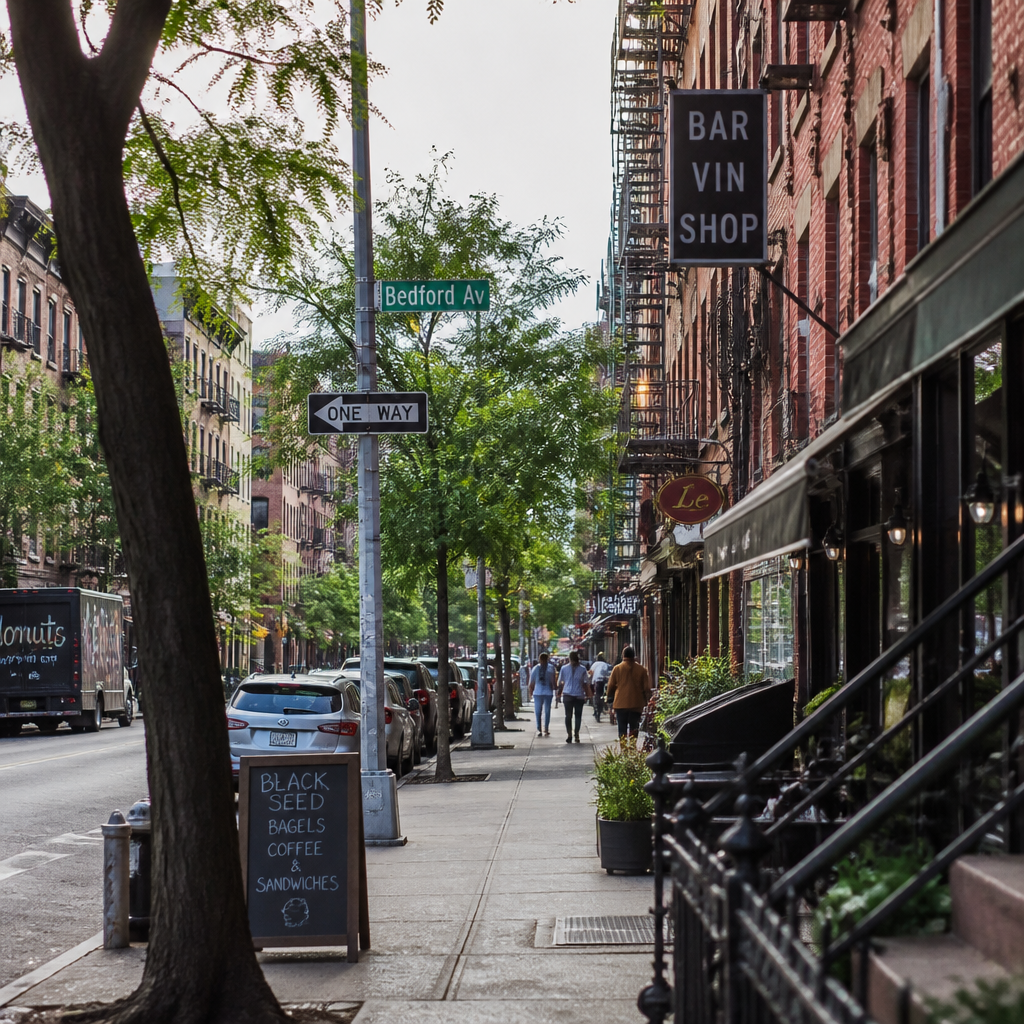
Start with your commute anchor. If you have a physical office, plug that address into Google Maps and test commute times from several neighborhoods during rush hour. A 40-minute commute from Astoria, Queens looks very different from a 40-minute commute from Park Slope, Brooklyn, because the trains, the lines, and the transfer complexity are all different. Do not assume subway commute times are interchangeable.
After commute, think about your lifestyle priorities in concrete terms. Do you need quiet streets and easy grocery access, or do you want walkable restaurant density and nightlife? Are you bringing a car (strongly not recommended for most NYC residents, but relevant)? Do you need specific school districts? Each of these factors should narrow your neighborhood shortlist to three to five areas before you start reviewing individual listings.
Boroughs and price expectations
Manhattan commands the highest rents across the board. Brooklyn neighborhoods like Williamsburg, DUMBO, and Park Slope are comparable in price to many Manhattan areas. Outer Brooklyn, much of Queens, and neighborhoods in the Bronx like Mott Haven offer more value, and some, like Astoria and Jackson Heights in Queens, have strong transit connections to Midtown and Downtown Manhattan. Ridgewood, on the Queens-Brooklyn border, has become a popular choice for renters seeking more space at lower per-square-foot costs.
No neighborhood recommendation in an article like this should override what you learn from actually walking the streets. If you can make one scouting trip to NYC before committing, do it. Even two days of walking three or four neighborhoods will tell you more than weeks of online research.

Building Your Remote Search Toolkit
Successful remote apartment search NYC requires using multiple platforms at once, not relying on a single source. No single listing platform carries everything, and off-market inventory, which is significant in NYC, does not appear on any public site at all.
Listing platforms worth using
StreetEasy is the most widely used platform by NYC renters and is the clearest starting point. Zillow and Apartments.com carry overlapping inventory and occasionally surface listings that do not appear on StreetEasy. For furnished short-term rentals that could serve as a landing spot while you continue searching in person, platforms focused on furnished apartments offer more flexibility than a standard lease commitment.
Set up saved searches on at least two platforms with email or push notification alerts. In a market this competitive, a listing you see 18 hours after it posts may already have multiple applicants.
What listing platforms cannot do
They cannot show you off-market apartments. A significant portion of NYC rentals, particularly in smaller buildings and co-ops, never appear on public listing sites at all. They are filled through broker relationships, building super connections, or word of mouth. For an out-of-state renter without local networks, accessing this inventory on your own is nearly impossible. This is the primary reason working with a local expert or relocation specialist produces meaningfully better results than going it alone.
Pro tip: When using StreetEasy, filter by "no fee" listings if you want to see apartments where the landlord covers the broker fee. Under the FARE Act, as of June 2025, landlords who hire brokers to market their listings are now responsible for paying that commission, not the tenant. Understand what fees a listing may involve before you tour, so there are no surprises in the application stage.
Virtual Tours: What to Ask and What to Watch For
Virtual tours are necessary but imperfect. A video call walkthrough with a broker gives you a real-time look at the space and lets you ask questions, but it can miss things that you would notice immediately in person. A pre-recorded video, while convenient, gives you no ability to redirect attention or ask follow-up questions. Both have a role in a remote apartment search, but neither replaces physical presence entirely.
What to cover in every virtual tour
Ask the person conducting the tour to walk slowly through every room and open every closet. Ask them to show the view from each window, including the view directly below. Ask them to walk to the building's front entrance, the hallway, and the elevator or stairwell. Ask about noise at different times of day. Ask how close the nearest subway entrance is and which lines it serves. Ask about the building's laundry situation and basement access. These are the things a staged photo or a carefully angled video call will not show you.
Pay attention to natural light specifically. NYC apartments vary enormously in how much light they receive depending on floor, orientation, and surrounding buildings. A south-facing apartment on the fourth floor may get excellent light. A north-facing unit on the second floor behind a taller building may be dark all day. Light quality cannot be properly conveyed through a video call without deliberate effort.
Sending someone you trust as a proxy
If you have a contact in NYC, a friend, a colleague, or a family member, ask them to attend an in-person tour on your behalf. Give them a specific checklist: photos of every room, a video walking the hallway and street outside, notes on noise, and a gut-check on whether the space feels like the listing photos. A single in-person proxy visit from someone you trust is worth more than three virtual tours.
The most honest signal you can get about an NYC apartment from a distance is the opinion of someone standing inside it, not a listing photo, not a recorded tour, and not a broker's description.
The NYC Application Package: Prepare It Before You Need It
NYC landlords have specific documentation expectations that are stricter than most other rental markets in the country. The standard income requirement is 40 times the monthly rent in annual gross income. That means if you are applying for a $3,500 per month apartment, you need to demonstrate annual income of at least $140,000. Some buildings set this threshold higher.
The documents you will typically need to submit include recent pay stubs, an employment verification letter, two to three months of bank statements, the previous year's tax returns, a government-issued photo ID, and a completed rental application. If you are self-employed or a freelancer, you may also need a CPA letter confirming your income. If you do not meet the income threshold on your own, you will need a guarantor who typically must meet an 80 times monthly rent threshold.
Remote-specific application challenges
For out-of-state movers, there are additional wrinkles. If your income is from a remote job, you will need an employment verification letter on company letterhead confirming your salary and remote work status. If you are relocating and starting a new job, get that offer letter and make sure it shows salary clearly. Landlords in NYC want to see that your income is real, current, and consistent.
Scan all your documents into a single organized PDF folder that you can email within minutes of completing a tour you are serious about. In a competitive market, the renter who submits a complete, clean application package within a few hours of a tour has a real advantage over the renter who says they are interested but needs two days to gather documents.
Avoiding Rental Scams as an Out-of-State Renter
Rental scams are a real problem in NYC, and out-of-state renters are disproportionately targeted because scammers know that remote renters are less likely to verify listings in person and more likely to feel time pressure. The scam formula is consistent: an attractive listing at a below-market price, a landlord or agent who cannot meet in person, and a request to wire money or send payment through apps like Venmo, Zelle, or CashApp before you have seen the apartment.
No legitimate broker or landlord in NYC will ask you to send money before you have toured the property. Application fees are capped, and no reputable agent will require upfront payment simply to show a listing. If someone pressures you to send a deposit before you can tour, treat it as a definitive red flag and walk away.
How to verify a listing is real
Search for the address on StreetEasy even if you found the listing somewhere else. Look for matching listings and compare photos, prices, and details. Scam listings often use photos stolen from legitimate listings, so run a reverse image search on any listing photos that look too polished. A listing that lacks a precise address, or that claims a specific address but shows photos inconsistent with what Google Street View shows for that block, deserves serious skepticism.
If a deal looks significantly below market for the neighborhood and building type, that is not a bargain. That is a signal that something is wrong. The NYC rental market is simply too competitive for real underpriced listings to sit available long enough to reach you.
When to Use a Specialized Relocation Service
Most out-of-state movers underestimate how much time, energy, and local knowledge a truly successful NYC apartment search requires. Going it alone is possible, but it comes with real costs: time spent on listings that do not match your needs, missed access to off-market inventory, uncertainty about whether you are paying fair market rate, and the stress of navigating a lease in a state whose rental laws you may not know at all.
A specialized NYC relocation service solves most of those problems at once. The core value is not simply access to listings. It is having someone with deep, current, neighborhood-level knowledge act as your advocate through the entire process, from matching you to the right areas based on your actual lifestyle and commute requirements, to negotiating lease terms on your behalf, to guiding you through the application and signing process.
For relocating professionals, remote workers, and families moving to NYC from out of state, the combination of access to off-market listings, personalized neighborhood matching, and end-to-end process management typically produces better apartments at better terms than independent search. The time saved and the mistakes avoided are the real return on using expert help.
RelocateNYC's process illustrates how this works in practice: a free initial consultation establishes your priorities, insider connections surface listings that never reach StreetEasy, and full guidance through the application, negotiation, and lease signing process means you are never making critical decisions in unfamiliar territory alone.
Comparison: Approaches to Remote Apartment Hunting in NYC
Here is a direct comparison of the three main approaches out-of-state movers use to find NYC apartments remotely, with honest assessments of what each delivers.
| Approach | What It Delivers | Key Limitation for Remote Renters |
|---|---|---|
| DIY Search via Listing Platforms (StreetEasy, Zillow, Apartments.com) | Wide public inventory, free to use, full control over search criteria and pace | No access to off-market listings; requires you to respond to listings in real time; no one to catch red flags or negotiate on your behalf |
| Traditional NYC Broker | Broader inventory than DIY, professional representation for tours and applications, knowledge of specific buildings | Broker relationship is transactional and volume-driven; limited personalized attention for out-of-state clients; no dedicated relocation process or neighborhood-matching consultation |
| Specialized NYC Relocation Service (such as RelocateNYC) | Personalized neighborhood matching, access to off-market listings, full process support from consultation through lease signing, advocate relationship rather than transactional | Not a fit if you prefer to search entirely independently; best value is realized when you engage early and share real priorities |
The right choice depends on how much time you have, how well you already know NYC neighborhoods, and how much risk you are willing to absorb in a market that does not reward hesitation.
Frequently Asked Questions
How far in advance should I start a remote apartment search for NYC?
Start the preparation phase, meaning neighborhood research and document gathering, eight to twelve weeks before your target move date. Active listing monitoring and applications should begin four to six weeks out, since most NYC apartments are listed thirty to forty-five days before their availability date. Starting too early means you will be searching inventory that does not match your actual move window.
Can I rent an NYC apartment without visiting in person?
Yes, but it requires extra diligence. Successful fully remote leases typically involve thorough virtual tours conducted by video call, a trusted proxy who visits in person on your behalf, careful verification of the landlord and listing, and a complete application package submitted promptly. Working with a local relocation specialist or broker who can attend tours and verify apartments on your behalf significantly reduces the risk of a fully remote commitment.
What income do I need to qualify for an NYC apartment?
Most NYC landlords require annual gross income of at least 40 times the monthly rent. For a $3,000 per month apartment, that means demonstrating $120,000 in annual income. If you do not meet this threshold, you will typically need a guarantor, who in turn must meet an 80 times monthly rent income requirement. Some buildings have higher thresholds, so confirm the specific requirement for each listing before investing time in the application.
What are the biggest red flags in remote NYC apartment searches?
Any request for payment before you have toured the apartment, in person or virtually, is a definitive red flag. Below-market pricing for a neighborhood and apartment type is another. Listings without a precise building address, landlords who cannot or will not do a live video call tour, and pressure to wire money or use payment apps like Venmo or Zelle before signing a lease are all signals of a scam. Verify every listing on StreetEasy and run reverse image searches on any photos that seem too good.
Do I still have to pay a broker fee as a renter in NYC?
Under the FARE Act, which took effect in June 2025, landlords who hire brokers to market their listings are now responsible for paying the broker's commission, not the tenant. You should not owe a broker fee unless you specifically hired and engaged that broker to work on your behalf. Review any listing's fee disclosures carefully and ask questions before signing anything.
Is a relocation service worth it for moving to NYC from out of state?
For most out-of-state movers, especially those without strong NYC networks, the answer is yes. The main advantages are access to off-market inventory that never reaches public listing platforms, personalized neighborhood matching based on your actual commute and lifestyle needs, and professional guidance through an application and negotiation process that operates differently from most other rental markets. The cost of a bad apartment decision in NYC, financial and logistical, typically exceeds the cost of expert help finding a good one.
What neighborhoods should I consider as an out-of-state renter new to NYC?
This depends entirely on your commute anchor, budget, and lifestyle priorities. There is no single right answer for every renter. What matters is that you evaluate neighborhoods on transit access, actual commute times at rush hour, your day-to-day lifestyle needs, and price per square foot rather than reputation or aesthetics alone. Areas like Astoria in Queens, Ridgewood on the Queens-Brooklyn border, and parts of Mott Haven in the Bronx offer transit access and more space at lower cost than Manhattan or prime Brooklyn. But any neighborhood shortlist should be built around your specific situation, not a generic recommendation.
Have you recently searched for an NYC apartment remotely? Share what worked, what surprised you, or what you wish you had known before starting.
References
- Guide to starting an out-of-state apartment search, including timeline and platform tips
- NYC apartment application checklist including the 40x income rule and required documents
- What renters need to qualify for an NYC apartment, including the FARE Act broker fee changes
- How to recognize and avoid rental scams in New York City
- Practical tips for renting an apartment remotely, including scam avoidance and checklist tools


Book your free
relocation inquiry
In 20 minutes, we'll understand your needs and create a personalized plan for your NYC move. No commitment, no pressure — just expert guidance.
+1 (917) 450-8909
Free 20-minute call
All 5 NYC Boroughs
Ready to make your
NYC move happen?
In 20 minutes, we'll understand your needs and create a personalized plan for your NYC move. No commitment, no pressure — just expert guidance.
.avif)